
Tow strap: a rescue tool… or an unnecessary risk?

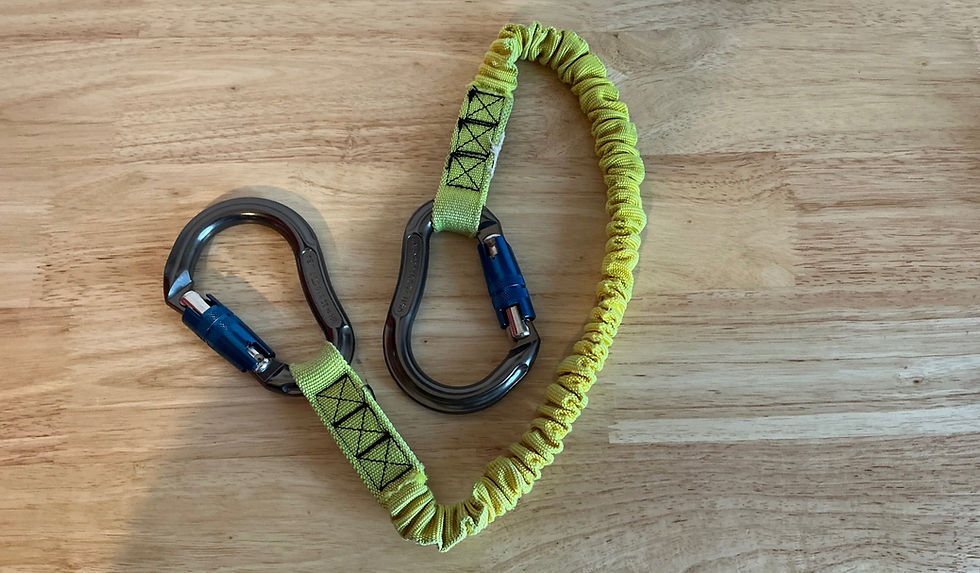
The tow strap, also called a cowtail, tow tether, or tow line, is a safety accessory used in whitewater. Introduced by the Germans in the 1980s to secure a rescuer or a victim, it was later adapted for towing a boat. When used correctly, it can facilitate certain rescues and towing operations, but it can also create additional risks if used incorrectly.
This post is intended as a reflection to fuel the debate on the use (or non-use) of a tow strap.
An accessory that many paddlers use, without knowing exactly what it is for, or how or when to use it properly.
Several names :
Cow tail
Pig tail
Monkey tail
Town line
Tow tether
Leash
Shock leash
What is it for?
To rescue and to be rescued.
It's essentially an extension for your quick-release belt , which creates a controlled attachment point and reduces certain risks during a rescue.
It can be used to:
Perform certain rescue techniques
Towing a boat (elastic tubular strap to absorb shocks and help maintain a more constant tension)
Towing an unconscious person
In difficult terrain, drag your kayak along the ground rather than lifting it
Recommended?
Yes...but only under certain conditions.
Only for someone who:
has already practiced releasing their quick-release belt in a real-life situation (e.g., TR2 training)
knows and respects his level of competence
Apply the basic rules: as short as possible, detachable point at the front and back, accessible knife
Never for:
Attaching oneself to one's boat so as not to lose it while sailing (already seen with a packraft)
To use it in a context equal to or greater than one's skill level
Always stay below your limit.
ATTENTION
The tow strap can be an excellent tool, but it can also pose an unnecessary danger if used incorrectly.
It is an additional accessory that can be used for attachment to branches, rocks, equipment, rope, etc. It must therefore be used with caution and in controlled situations.
A well-documented fatal accident occurred involving a tow strap in a Class 2-3 rapid. The victim became trapped underwater and could not be rescued in time: https://www.americanwhitewater.org/article/34177/
Examples of rescue techniques:
Swimmer with a rope attached (live bait rescue). The long rope allows you to quickly tie yourself in to assist a swimmer.
Victim participation in rescue (extraction) . Once the rope bag is thrown, the victim can sometimes participate in their own rescue by clipping the end of the rope. For the rescuer, accessing the webbing is often faster than reaching for the D-ring behind the life jacket, thus increasing the chances of intervention.
Unconscious victim. Pushing an unconscious victim to the edge is a feat. A strap can help reach the shore more quickly.
Zip-line. The strap allows you to attach yourself to a Zip-line while keeping your hands free to hold a victim.
Temporary anchoring . Allows you to anchor yourself to a tree before throwing a rope bag to stabilize your position on a slippery surface when you are alone.
Towing a boat . Towing a boat becomes much more difficult if it is full of water. And much riskier if the maneuver takes place upstream of a dangerous rapid.
An excellent example of its use in this rescue. He uses his strap to secure his kayak in order to save a victim from a 60-foot drop: https://youtu.be/qs_Mo05dxv8?si=HAk9s82W0omOFxiy
Carabiner
Some straps are:
sold with a locking carabiner (NRS, Astral)
sold with a non-locking carabiner (probably as a cost-saving measure/outdated)
sold without carabiner
Personally, I prefer models without a carabiner, because you avoid paying for a model that you're not going to use.
Reminder: Whitewater = lockable carabiner only. Otherwise, you increase the risk of entanglement. Several documented accidents involve this type of carabiner.
My personal choice: pear shape (HMS) with automatic system (twist lock), which allows you to go over a knot in various rescue scenarios.

How to use it (or how not to use it)
Always attached to a detachable point at the front and back. Never to a fixed element like a PFD strap. I know the rule to avoid absolutes in rivers...but this is one of them.
Most modern PFDs feature a plastic D-ring with an integrated slot. Simply pull on the long end to release the carabiner from the ring. Astral = a tab with a button.
Other factors to consider:
Choose the shortest possible route depending on the intended use (rescue only vs. boat towing).
Use it only in situations where you are completely comfortable . If I am comfortable in class 4, I will use it in class 2-3.
Always weigh the risk against the benefit ... most paddlers don't really need it. Ask yourself if the benefit justifies the added risk.
Always carry a knife
Guide tips
As a guide, this tool is a game changer. It saves us a huge amount of time when we're coaching beginner kayakers. It allows us to retrieve a boat and a swimmer at the same time or to tow a tired client in calm water.
Personally, I cut off the metal ring and replaced it with a carabiner. This allows me to attach or detach the sling more quickly depending on the river. For sections where I have a lot of control (when I'm guiding), I attach the sling. For more challenging river sections or narrow creeks, I take it off.
Comparison of tow straps (cow tails) available on the market

My rating out of 10 + comments | Retracted length / Extended length | Country of manufacture | Web link | |
WRS | 2/10 +
-
| 38-50 cm | ? | |
Palm | 9/10 +
-
| 50-75 cm | Vietnam | |
Peak UK | 3/10 +
-
| - 70 cm | China | |
North Water | 7/10 +
-
| 60 - 102 cm | Canada | |
Level Six | 5/10 +
-
| 53 - 89 cm | China | |
NRS | 6/10 +
-
| 48 - 84 cm Or 84 - 135 cm | ? | |
Salus | 8/10 +
-
| 66 - 112 cm | Canada | |
Astral | 4/10 +
-
| 183 cm | ? |
Conclusion
A tow strap can be a very useful safety tool in whitewater, but only if its use is properly understood and practiced. Like many river rescue techniques, it should be learned in a training setting and practiced regularly. In river safety training (TR1 and TR2), we practice these techniques precisely to know when to use this tool… and when not to.
Looking forward to seeing you on the water,
Alex


Comments